
Common procedures in Alzheimer's research
A Youngtimers Guide ・ Last Reviewed Nov 12 2025
Participating in a study often means undergoing a mix of cognitive tests, imaging scans, and tissue collection. Some are straightforward. Others can be invasive or uncomfortable. Most procedures take place in a clinic, but some activities can be handled with a home visit or even a virtual appointment.
Here’s what to expect:
Clinical Assessment
Includes reviewing your family history, physical and cognitive health, emotional well-being, personality, and behavior. A clinical assessment can be done in clinic or in a virtual appointment. This can take up to 2.5 hours.
Cognitive Testing
These tests are designed to find the limits of your memory, language, planning, problem-solving, and concentration. Sometimes, people feel exhausted or report feeling “dumb” afterward.
Some tests are completed using pen and paper, some with oral questions posed by testing staff, and others are performed on a smartphone, tablet or computer. Cognitive tests typically happen in clinic and take up to 1.5 hours. For some studies, there’s a mobile app component that takes place at home.
MRI Scans
MRI scans use magnetic imaging to check brain volume and structure. This involves lying still on your back with a velcro strap positioned across your forehead to hold your head still.
During the scan, you will hear the loud noises of the machines. Headphones will be provided to help minimize the noise. The scan can take up to 1.5 hours.
PET Scans
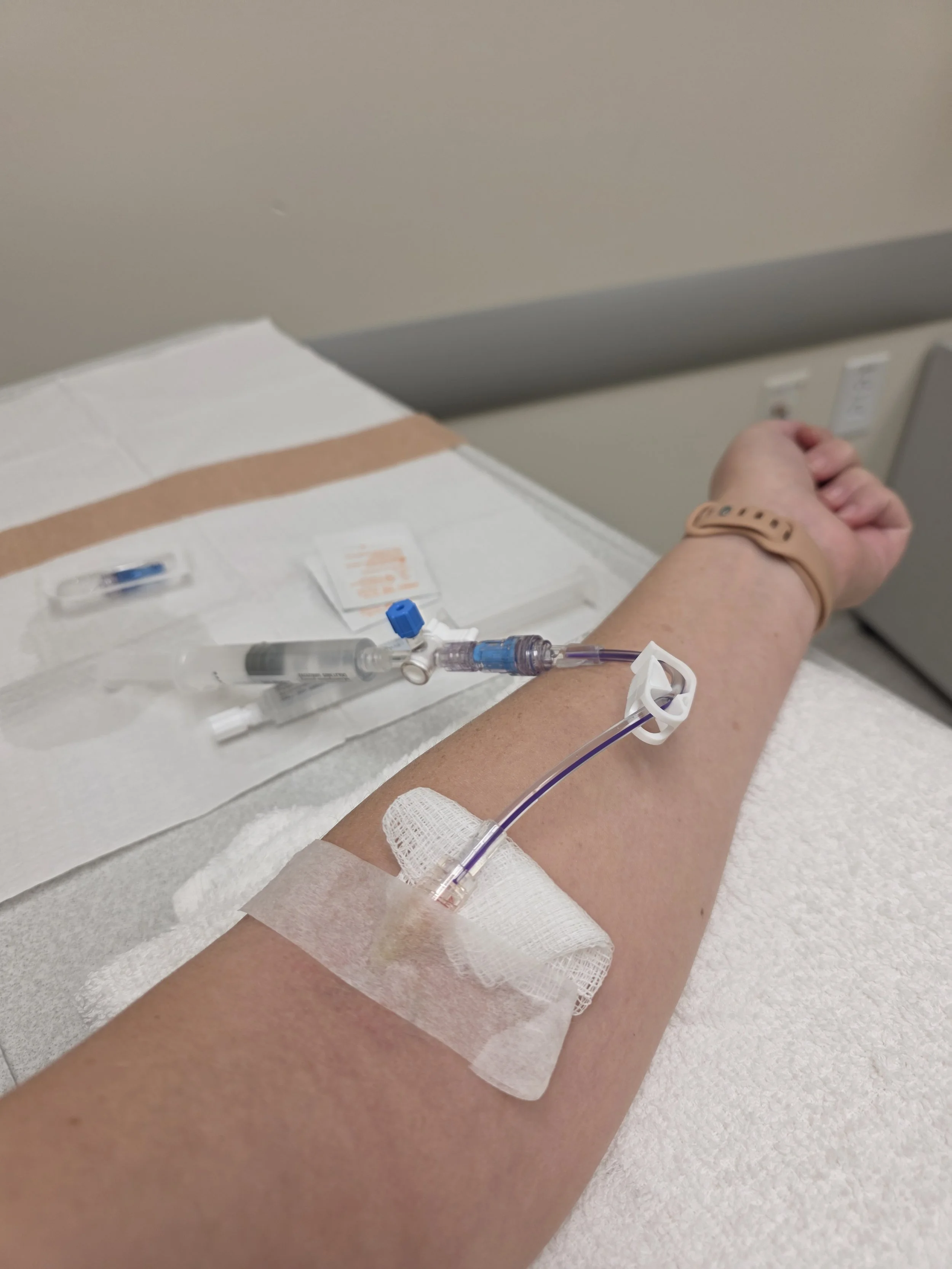
A DIAN patient awaits the radioactive tracer injection before a PET scan.
PET scans use chemicals called radioactive tracers to measure brain activity and to measure the amount of specific proteins in the brain. These scans help scientists visualize amyloid or tau proteins in your brain in real time.
During the procedure, a small amount of the radioactive tracer is injected into a vein in your arm using a small plastic IV tube. After checking vital signs, you are brought into the PET scanner where you lie still for scans. Unlike an MRI machine, the PET scan machine is not noisy. The procedure can take 1.5 - 3 hours altogether.
Some people might be alarmed when they hear the word ‘radioactive,’ but adverse reactions to radioactive tracers are rare.¹ When they occur, they’re typically mild. The scans use a very small amount of tracer, it clears quickly from the body, and most people have these scans only occasionally.
If you’re trying to conceive, it’s recommended to wait at least 24 hours after a PET scan before trying. The radiation exposure during that short window can influence early embryo development.
Bloodwork
Blood is used to examine what proteins are changing in the body, including amyloid and tau. In this procedure, blood is collected from your vein, often 3 vials (approximately 6 tablespoons) from your forearm. The collected blood is then used for:
Safety monitoring, such as checking blood cell counts
Genetic testing, to determine whether you carry a genetic mutation that causes Alzheimer’s disease
Measuring biomarker changes, such as amyloid and tau
Levels of the investigational drug in your blood stream
Blood biomarkers may one day replace spinal taps and expensive scans for Alzheimer’s diagnosis.
Lumbar Punctures (Spinal Taps)
Lumbar punctures are used to collect cerebrospinal fluid (CSF). CSF is crucial to Alzheimer’s research because it gives scientists a direct window into what’s happening in the brain. During the procedure, your lower back is numbed with lidocaine, and a very thin needle is inserted to collect the CSF.
The procedure itself typically takes about 30 minutes. After the CSF is collected, you’ll typically lay flat for at least 1 hour to help heal the puncture. Many clinics recommend bed rest for at least 24 hours after the procedure.
Somewhere between 10% and 40% of people who have a lumbar puncture develop a headache (called a post-dural puncture headache (PDPH) or spinal headache) afterward, typically 1-3 days after the procedure. A person’s risk of headache is higher if they are young (aged 20-40), female, or dehydrated.
The headache is typically positional, worsening when a person sits or stands and relieved when a person lies down. Most are managed with bed rest, hydration, and over-the-counter pain relievers. Some people who develop a headache may require a simple procedure called a “blood patch” to stop the CSF leak that causes the headache.
Ask the Expert Videos: Familial Alzheimer’s Disease Research


Sources
Meher BR, Agrawal K, Gnanasegaran G. Review of Adverse Reactions Associated with the Use of Common Diagnostic Radiopharmaceuticals. Indian J Nucl Med. 2021 Apr-Jun;36(2):163-167. doi: 10.4103/ijnm.ijnm_219_20. Epub 2021 Jun 21. PMID: 34385787; PMCID: PMC8320829.